Corridor // SUTD 50.046 Cloud Computing and IoT
Route around the crowd.
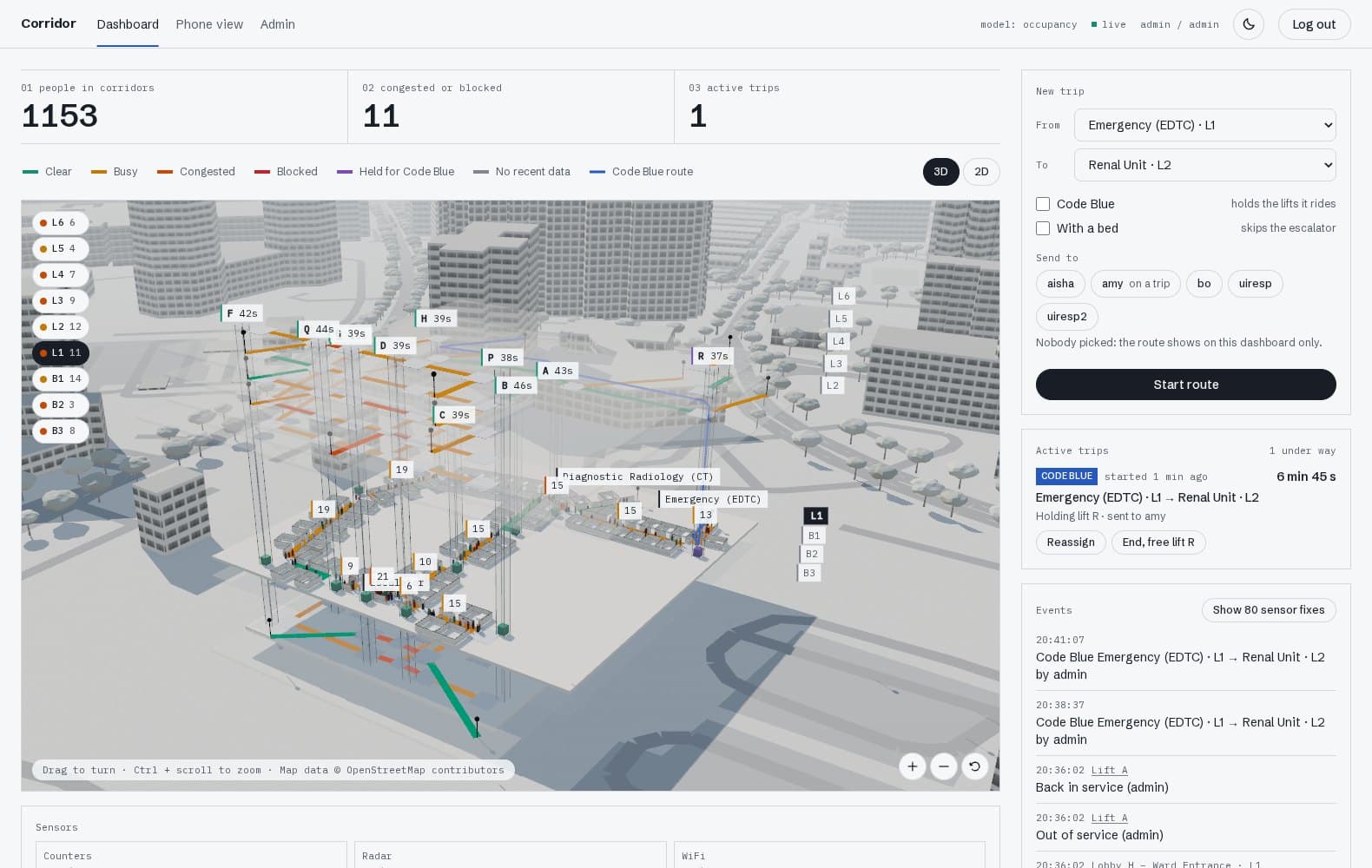
Sensors count people in every hospital corridor. Code Blue teams and porters get a clear route in under two seconds.
02 / 10 · The hospital
Minutes are lost in corridors.
Patients, porters, visitors and staff share the same corridors and a handful of lifts. Signs show the shortest path, not the clear one.
- 53 min
- average transfer to surgery, target 30Lin 2022
- 39.3%
- survival if shocked within 2 min, vs 22.2%Chan 2008
- ~340
- patient transfers every dayMendlovic 2021
03 / 10 · Doorway counters
Every doorway counts.
A VL53L8CX time-of-flight sensor above each doorway measures the distance to the floor in a grid of zones. Someone walking under it lights the zones in order, so the node knows they went in or out.
The base count, and the only signal that scales past three people.
04 / 10 · Radar
It sees who stands still.
An LD2450 radar mid-corridor tracks up to three people, including ones standing still that a doorway never sees again. When it sees more people than the counters, the count goes up.
05 / 10 · WiFi motion
And knows when it's empty.
An ESP32 watches how the WiFi signal between it and the access point changes as people move through it. No radar targets and no motion for a minute resets the corridor to zero, so counting errors never pile up.
06 / 10 · The node
One small node per doorway.
- ESP32
- Reads the sensor and publishes counts over WiFi with MQTT.
- VL53L8CX
- Multizone time-of-flight sensor, looking straight down.
- Same board
- The radar and WiFi nodes run on the same ESP32.
07 / 10 · The crowd
A corridor fills up.
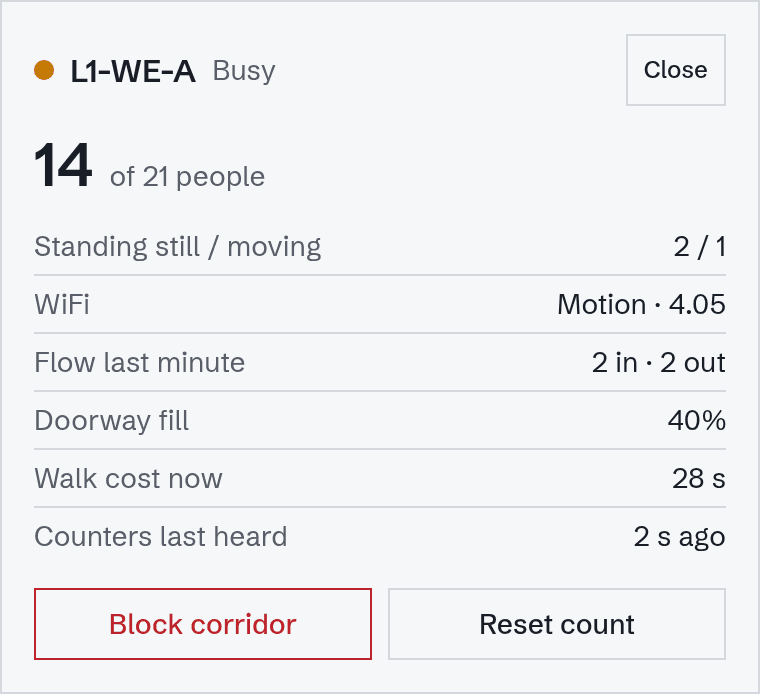
A ward round stops in the Level 1 north corridor. The counters climb, the radar sees people standing still, and the corridor's walking cost rises with how full it is.
cost = walk time × (1 + α × fullness)
08 / 10 · The reroute
The route moves first.
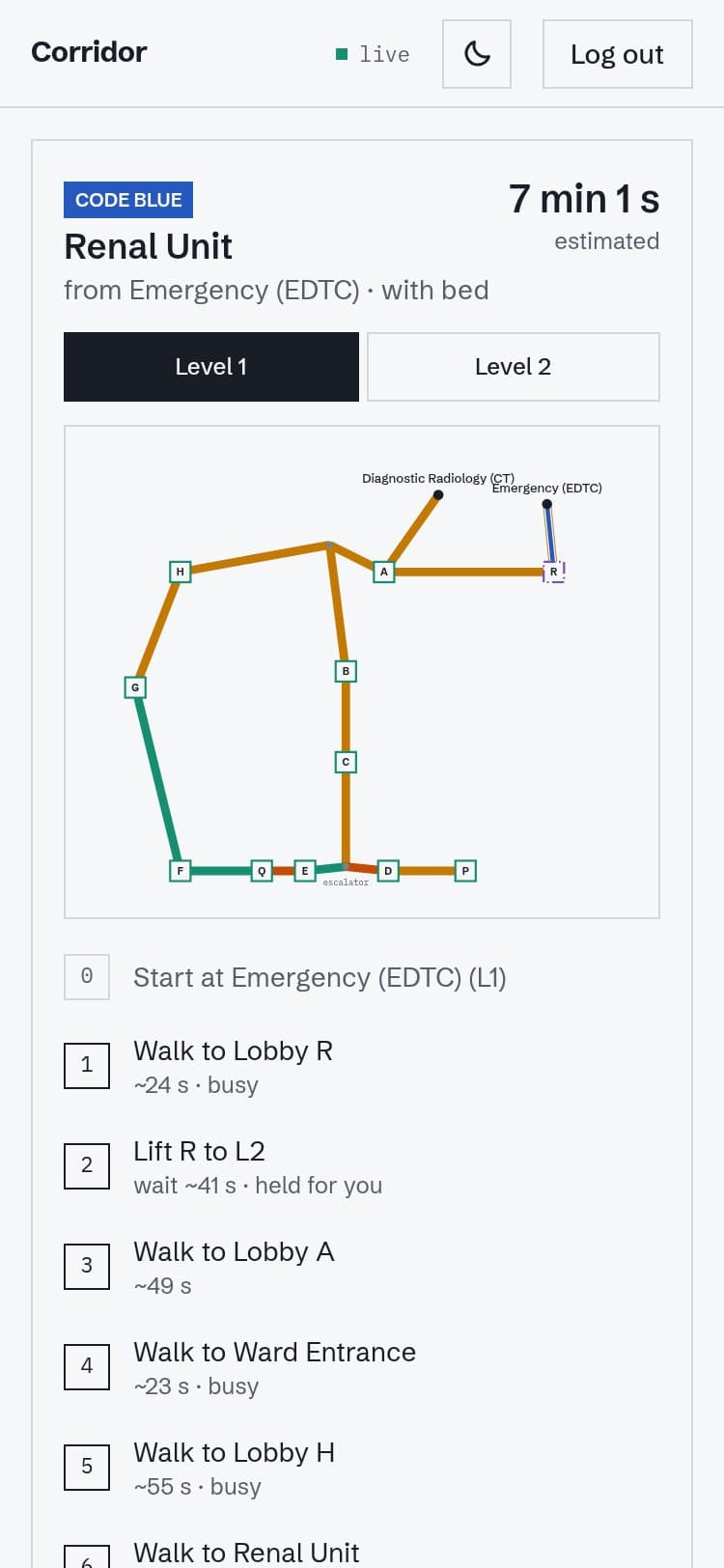
The Code Blue trip from Emergency to the Renal Unit is rerouted through Lift R and the Level 2 corridor. The lift is held for the team, and every responder's phone updates in under two seconds.
09 / 10 · The system
Runs on our own servers.
| ESP32 nodes | MQTT | counts, radar, motion |
|---|---|---|
| Routing service | Go | fusion, Dijkstra, trips |
| Storage | PostgreSQL | layout, readings, labels |
| Interface | Next.js | dashboard, phones, admin |
| Deploy | Docker, k3s | inside the hospital network |
10 / 10 · Team
Built at SUTD.
- Baddipadige Amith Reddy
- Wonna Tun
- Ryan Pek Yi Zhe
- Woo Jon Hou Ainsley
Floor plans are schematics traced from Tan Tock Seng Hospital's public visitor floor plans; distances approximate; not affiliated with TTSH. Buildings, roads and trees from OpenStreetMap (© OpenStreetMap contributors, ODbL); façades, people, traffic and crowding are illustrations.